How JavaScript Works And Execution Context 🔥

Hi, I’m Richa — a Senior Frontend Engineer with 5+ years of experience building scalable, production-grade web interfaces for enterprise and consumer applications. I work primarily with React, TypeScript, and modern frontend architectures, focusing on component systems, performance, and maintainability. Most of my experience comes from building real-world products in regulated domains like banking and insurance, where clarity, reliability, and long-term ownership matter more than quick demos. Through this blog, I write about frontend engineering fundamentals, scalable UI design, problem-solving, and the lessons I’ve learned working on large codebases. My goal is to share practical insights — not shortcuts — for developers who want to grow strong engineering foundations. I also mentor early-career developers and strongly believe that curiosity, asking the right questions, and understanding why something works are more important than memorizing tools. If you’re serious about improving as an engineer, you’re in the right place.
If you are or want to be a Good JavaScript developer, then you must know how the JavaScript programs are worked internally. In this Blog We are learn How javaScript work and Execution Context.
What is an Execution Context?
👉The Execution Context contains the code that's currently running, and everything that aids in its execution. In other words Everything in JavaScript happens inside an Execution context
Types of Execution Context
- Global Execution Context (GEC)
- Function Execution Context (FEC)
Global Execution Context (GEC)
Whenever we execute JavaScript code, it creates a Global Execution Context (also knows as Base Execution Context).
Function Execution Context (FEC)
When we invoke a function, a Function Execution Context gets created.
Let understand this concept with the help of Container
We can assume this container is Execution Context in which whole javaScript Code is executed.
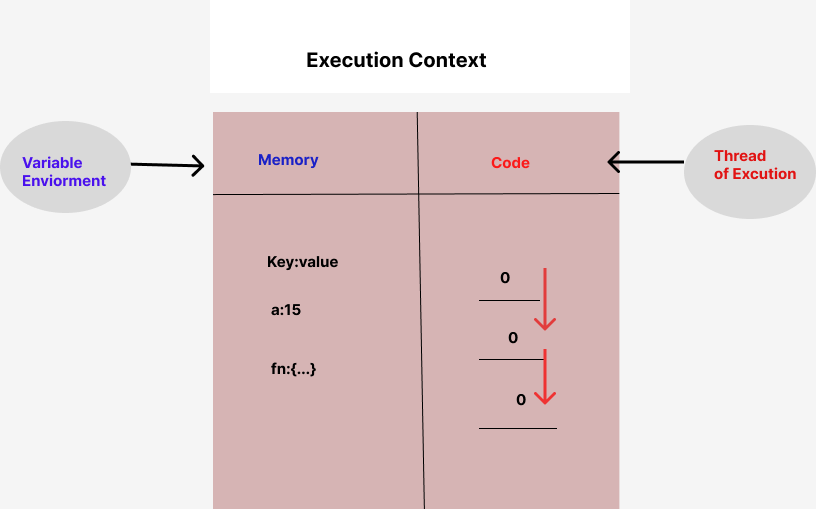
So let us now see How this Execution Context actually looks like. Let suppose the above diagram is Execution Context.
The First Component is also know as the Memory Component so this is place where all
the variables and functions are stored as key-value pairs something like this key value,
if suppose we have a variables a which is equivalent to 15you can refer the block diagram. It will be stored over here and similarly function are stored over in Memory Component
This Memory Component is also Know as Variable Environment
The Second Component of this Execution Context is the Code Component this
is the place where code is executed one line at a time it is also know as Thread of Execution
Note:-JavaScript is synchronous single-threaded language
What is Synchronous single-threaded?
Synchronous single-threaded that means JavaScript execute one command at a time
in a specific order so that means it can only go to the next line once the current line has
been finished executing.
👉 Resources Check out some of these resources for a more in-depth:- JavaScript Execution Context
In closing
So we have discussed how JavaScript programs are worked internally in this Blog. That’s it and if you found this article helpful, please hit the 👏 button and feel free to comment below! I’d be happy to talk 😃.
I write web development articles on my blog @richak.hashnode.dev and post development-related content.